Thursday, 18 November 2010

Complete the work

  • A complete description of the station as it currently is alongside a description of exactly how it existed in 1912. I currently only have bits and pieces of information about the building to base my ideas and drawings on. 
  • Visit more archives to build up a complete picture of the station and the exterior space as they stand at the moment. As well as the building that currently sits on top of it. 
  • More surveying and photos need to be taken of the site to build up a complete description of the atmospheres that exist there at different times of the day.
  • Complete archive and document spatial biography over time, arrange all information carefully into an archival document.

Station Facade and juxtaposition

Just a quick look at the Juxtaposition between the station facade and fenchurch place. This image demonstrates the theatrical grey stock brickwork and deep walls and doors of the entrances, contrasted against the haphazard pavers outside the building.


Wednesday, 17 November 2010

Drawings of building


Fenchurch Station 1912


Fenchurch Station 2010

The change over time of the stations public space and the the spatial composition of the space outside in Fenchurch place raise all sorts of interesting questions about how the public realm and the high street associated with this curious area could develop over time. These two spaces in a symbiotic relationship could evolve even further. The current spaces and conditions of the stations and area work well, but do not begin to challenge the way a station/public area/high street could work in these sorts of places. How could I develop this area to challenge the notion of the high street, to improve the high street, to change the high street. 

Questions

Could I make the public realm and the transition between the disorganised nature of Fenchurch Place to the highly structured nature of the station a continuous public realm, where the transition between the two areas isn't so intense? Perhaps I could tweak this intensity through an architectural intervention? What form would this take? Could the current feeling of ascension into the station via the escalators be challenged? what form would this challenge take- perhaps the public realm could continue under the station and appear further underneath. Need to wait for the next brief before I continue with these ideas.

History of the site

After research of the station, in particular the relationship between the exterior forecourt (fenchurch place) and the interior station and platforms we discovered that up until the late 80's the station platforms area existed as a traditional railway station steel and glass shed typology.


Fenchurch Station 1912


Fenchurch Station 2010


Original Station designed by Berkley in 1849

The station structure of Berkley in the 1800's never changed until an office block was placed on top as mentioned before. In doing so the entire interior space has been squashed making for a hugely intense and strange atmosphere. In discovering this change in spatial qualities, I have also discovered the space of Fenchurch place has grown, in doing so this observation has raised questions bout the relationship between the interior station space and the exterior fenchurch place space. It almost feels as though the space and associated atmosphere has been squeezed out of the building through the the orifice of the stations entrance. It feels like there some sort of symbiosis existing between these two spaces where one has reacted to the other. To show this change over time I have drawn two sections of the station showing one based in 1912 and the other today in 2010. Please look above


Initial Drawings

Initially I was interested in showing the juxtaposition between the two atmospheres of inside and outside the station. I tried to demonstrate this through an axonometric section. However the theatrical presence of the stations facade was lost in this drawing-


I also began on an 1:20 Planometric of three entrance doors of the stations facade, to show the contrast between the fenchurch places messy and sometimes irregular form, against the highly organised, functional atmosphere of the stations interior. However it was decided this missed the curious nature of the stations interior, which is what I wanted to focus on for the archive.


Tuesday, 16 November 2010

Questions

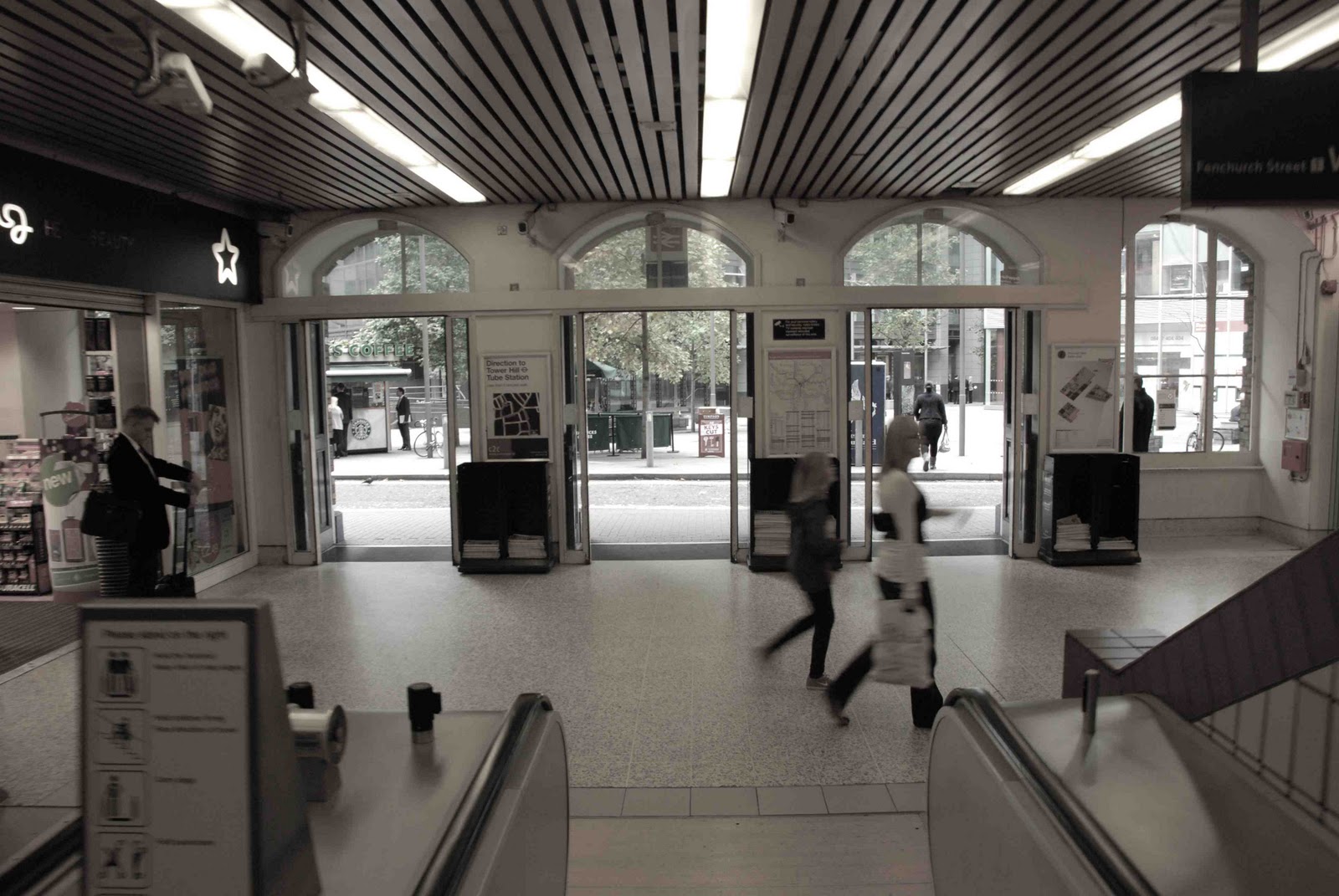
Another curious feature of the station is the incredibly low ceiling of the stations foyer and platform area. Completely at odds with the stations facade, it is obviously a new addition to the station, again setting up tension in the space which this time talks about a situation created through the development of an newer addition. As part of the biographical archive for this project I feel learning about how these spatial conditions have come about would make interesting reading or documentation.


Fenhchurch street station Ideas

Fenchurch street station is the oldest station in the City of london, built in 1849 it originally worked on a cable - tow network which was later changed to an electrical network in the 20th Century. What is initially most striking about the facade is the angle at which it sits in Fenchurch place. This striking position combined with its theatrical facade sets up a curious tension within the space in Fenchurch place and within the station. This is a static tension which seems to be in balance between the varying scales and ages of buildings and the pressure cooker atmosphere of the stations interior. This tension feels like it is held together by the theatrical dominance of the stations facade. There is also a tension between the atmospheres of the stations interior and the stations exterior, atmospheres which come about, I feel mainly through the uses of the different spaces.


Fenchurch Road, as a spatial study I felt it was important to look into the spatial relationships between the street and the place.


Fenchurch place


Fenchurch street station


The moment where the tension between the station and fenchurch street station is at its greatest.


Wednesday, 27 October 2010

Quick thought/ Site change

Changing site to potentially Fenchurch station and the square to the back of it. As such I have been considering how to represent the archival stuff for the station. Perhaps in the style/look of a station ticket office or other places in stations where information is presented in a particular idiosyncratic way.


Walid Raad at the Whitechapel Art Gallery

The work of the artist Walid Raad has a curious archival quality about it. He is documenting what he finds but adding a personal take on these findings, his work mainly concerns the various wars that have taken place in Lebanon, however he also looks into a variety of traumatic human historical events. However the graphic way of presenting these findings leaves ones guessing and asking many questions. I found a series of pieces he produced particularly haunting.

These were a series of varying blue shaded canvases- no texture, just what seemed to be large blue negatives of photographs yet to be developed. These prints were discovered in the rubble after a bombing in Beirut. They were then developed to see if anything existed on them. All that were found were small black and white portraits of men and women either on their own or in groups. One small picture (A6) per canvas (A0). After researching into the people in the photographs Raad found out they were men and women who had been lost at sea during the late 70's and early 80's. 


I find it very difficult to describe how and what it is about this layering and progression of memory, loss, discovery makes me feel, but it's overwhelmingly powerful. An interesting way of representing and documenting history. Perhaps the way they are presented makes them so powerful, or maybe its just the back story which helps achieve this.


How to make an archive? Naomi V. Jelish Archive

One thing we have been asked to look at as part of the most recent brief is documenting our findings of the development of an area in the style of a biography- but as an archive? How does one do this?- had a chat with Annabel (or replacement tutor for Christian) Who showed us a series of different ways of acheiving this. As the brief says you could document it in a seris of postcard- or perhaps if I am doing a look at the train station perhaps there is a way of presenting it which make it look like they are parcels. Perhaps there is some way information is archived which relates to train stations?

Look into this.


ar·chive  (ärkv)
n.


1. A place or collection containing records, documents, or other materials of historical interest. Often used in the plural: old land deeds in the municipal archives.
2. Computer Science
a. A long-term storage area, often on magnetic tape, for backup copies of files or for files that are no longer in active use.
b. A file containing one or more files in compressed format for more efficient storage and transfer.
3. A repository for stored memories or information: the archive of the mind.
tr.v. ar·chived, ar·chiv·ing, ar·chives
1. To place or store in an archive.
2. Computer Science To copy or compress (a file) into an archive.


Archive's we have been looking at include the Naomi Vs Jelish archive. This is such an interesting read and look at the website mainly because the back story is so intense and rich. Thus adding another layer of intrigue to the drawings. Beautiful.


In July 1991, 13-year-old Naomi V. Jelish and her family mysteriously vanished from their home in Kent, after a tragic year in which her father died after attempting to save her younger brother from drowning. Shortly after the family's disappearance, John Ivesmail, a retired science teacher at Naomi's school, unearthed a collection of the teenager's remarkable drawings.

In the years following the disappearance, John attempted to trace what had happened to the family through an investigation of Naomi's incredible artworks. John hoped to throw light on the family's bizarre vanishing by mounting an exhibition of the youngster's work.

John died in 2002 before his desire to open the exhibition could be achieved. Despite this, the show John had planned was realised in the presentation of Naomi's work at the Riflemaker Gallery in 2004, overseen by the artist Jamie Shovlin. Since their early nineties disappearance, Naomi and her family have never been heard from.

In the 10 years prior to his death, John Ivesmail sent copies of many of the documents he accumulated, in his attempt to bring Naomi's work to a larger audience, to friends and colleagues seeking advice and an assessment of his work. We are pleased to be able to display the most comprehenssive collection of this material to date.

With the assistance of Jamie Shovlin we are also able to present a number of supplementary documents and examples of Naomi's drawings allowing us to contextualise the archive and place it within the framework begun with the Riflemaker exhibition of Naomi's work and its subsequent display at the Saatchi Gallery whilst also addressing many of the questions raised through the recovery of additional works by Naomi in July 2004.